Born Again Was Never in Earlier Manuscripts Nicodemus
The Bible's New Testament has three pericopees nigh a man named Nicodemus who had 2 interesting encounters with Jesus of Nazareth. All three episodes are in only one of the four NT gospels–the Gospel of John. I believe this alone suggests that the sovereign hand of God was revealed in these incidents. And when people read them, they often wonder if Nicodemus did what Jesus told him to practice–be built-in once again.
Nicodemus was a prominent Jewish man who came to Jesus one night, early in Jesus' itinerant ministry. He came at nighttime, apparently surreptitiously to avoid being known about information technology by his colleagues. For, Nicodemus was an important member of the religious council in Jerusalem, called the Sanhedrin. These lxx men controlled the religious life in State of israel, especially all matters at the temple in Jerusalem. The Sanhedrin was the group that eventually had Jesus arrested, condemned him on the improper charge of blasphemy, and, according to some NT texts, pressured Governor Pontius Pilate of Judea to crucify him due to their jealousy of him (Matt. 27.xviii).
We read, "Now there was a Pharisee named Nicodemus, a leader of the Jews. He came to Jesus by night and said to him, 'Rabbi, we know that yous are a teacher who has come from God; for no ane tin do these signs that you lot do apart from the presence of God.' Jesus answered him, 'Very truly, I tell you, no one tin can see the kingdom of God without being born from above.' Nicodemus said to Jesus, 'How tin can anyone be born subsequently having grown old? Tin can 1 enter a second time into the mother'south womb and be built-in?' Jesus answered, 'Very truly, I tell you, no ane can enter the kingdom of God without existence built-in of water and Spirit. What is built-in of the flesh is flesh, and what is born of the Spirit is spirit. Practice not be astonished that I said to you lot, "You must be born from above." The current of air blows where it chooses, and you lot hear the sound of it, but you lot do not know where it comes from or where information technology goes. Then it is with everyone who is born of the Spirit.' Nicodemus said to him, 'How can these things be?' Jesus answered him, 'Are you a teacher of State of israel, and yet you do not sympathise these things?'" (John 3.1-10 NRSV).
Accordingly, Nicodemus, being a Pharisee and member of the Sanhedrin, appears to have been a noted Torah teacher in Israel even though this is not affirmed in any ancient, rabbinical writings. For Jesus really said to him, "Are y'all the teacher of State of israel."
Many English language versions of the Bible, including the NRSV here, do not quite care for this text every bit it reads in the original Greek manuscripts. The word in the Greek text for instructor, here, is didaskolos, and information technology appears twice in this pericope. The first time is in v. 2, with Nicodemus proverb to Jesus, "We know you are a instructor." The NRSV has this correct, "a teacher." That is, since didaskolos does not have the article, ho, didaskolos is indefinite and therefore should be translated "a instructor."
However, in John 3.x the NRSV reads, "Are you a teacher of Israel, and yet you practice not sympathize these things?" The Greek text hither has the commodity, thus ho didaskolos, so it should be translated "the teacher." The reason this is important is that it is oftentimes thought by Bible readers that Jesus introduced a new idea when he told this Torah teacher Nicodemus, "no one can see the kingdom of God without being built-in from above." Many well-known English translations, such as the King James Version and the New International Version, translate Jesus latter clause "born again" instead of "built-in from above," though both are correct translations. Yet Jesus was not introducing a new idea not found in the Jewish scriptures. That is why he later said to Nicodemus, "Are you a [read "the"] teacher of State of israel, and yet you do not empathise these things?"
This idea of beingness "built-in again" or "built-in from in a higher place" is very prominent in the prophetic writings of the Jewish Bible, in Jeremiah and Ezekiel, except that they practise not use these expressions. Jeremiah says on behalf of God, "The days are surely coming, says the LORD, when I will make a new covenant with the business firm of Israel and the house of Judah. . . . I will put my law within them, and I volition write it on their hearts" (Jeremiah 31.31, 33).
Ezekiel describes information technology this mode, speaking on behalf of God, "I will give them 1 heart, and put a new spirit inside them. I will remove the eye of stone from their flesh and give them a heart of flesh, so that they may follow my statues and keep my ordnances and obey them" (Eze xi.nineteen-twenty). He afterward calls it "a new middle" and "a new spirit" (36.26).
So, when Jesus told Nicodemus he needed to be built-in again, Jesus was only alluding to these texts of Jeremiah and Ezekiel about getting a new centre and new spirit from God. The old covenant that God made with Israel through Moses gave them the Police, but it could not give them the Spirit by which to obey the Police more perfectly. That is the reason for the necessity of the new covenant by which a person becomes empowered by the Spirit of God.
Thus, Jesus was talking to Nicodemus well-nigh the new covenant. That is how nosotros get ii parts of the Christian Bible: Onetime Testament (=Covenant) and New Testament (=Covenant). Thus, Jesus came to begin the new covenant equally a personal, inner transformation of the person by means of the Spirit of God.
Jesus had explained to Nicodemus that this personal, inner transformation occurs by "being born of h2o and Spirit." There has been no consensus amid Christians on what Jesus meant past this. The Catholic Church has interpreted it as water baptism, so that joining their church by ways of water baptism is being built-in again. Many other Christians have believed it means merely a spiritual birth. Simply they accept fifty-fifty disagreed about what the "water" ways. Some say it metaphorically refers to the scriptures. I am persuaded that Jesus refers to breaking of a pregnant woman's h2o just earlier she gives birth, so that Jesus means it literally every bit a reference to physical nativity. Thus, he is further contrasting physical birth with spiritual birth. However, I am not contentious with past young man brethren about the proper interpretation of water hither.
But I do believe that Jesus does not mean born again is water baptism. This is similar to how Jews believed about being a child of God and thus being in God's kingdom. They had the idea that if you were a Jew, that made you a child of God. Not quite. John the Baptist opposed this idea past proverb, "Practice not presume to say to yourselves,'We have Abraham as our antecedent'; for I tell you, God is able from these stones to raise upwards children to Abraham" (Matthew 3.9).
Jesus addressed this issue even farther. We read in John nearly a later encounter he had with interlocutors, "They answered him, 'Abraham is our begetter.' Jesus said to them, 'If you were Abraham's children, you would be doing what Abraham did, only now you are trying to kill me, a man who has told you the truth that I heard from God. This is not what Abraham did. You are indeed doing what your father does. . . . You are from your father the devil, and you lot choose to do your father'due south desires'" (John 8.39-41, 44).
And then, the Johannine Jesus was speaking to both Nicodemus and these Jewish interlocutors spiritually rather than literally. That is, yep, they were literal descendants of Abraham, but the latter had proved from their actions that they were not spiritual children of Abraham.
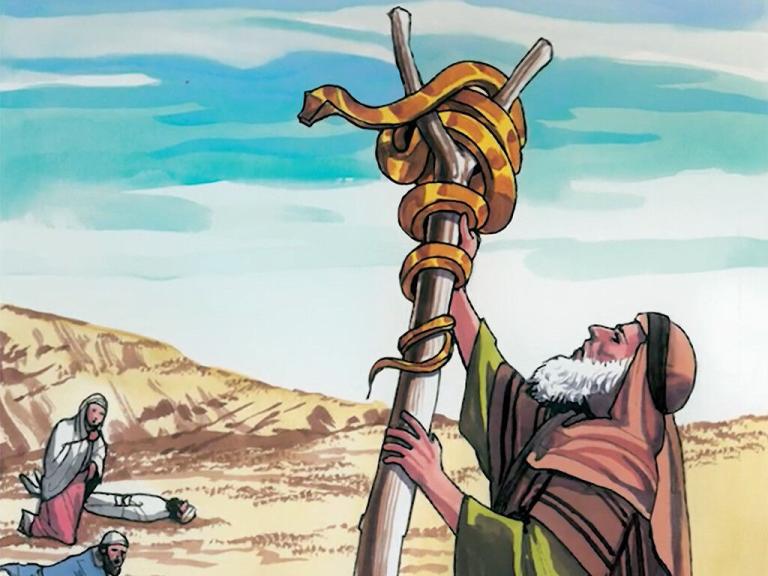
Right later on Jesus told Nicodemus he needed to be built-in over again, Jesus explained how that happens. He said, "just as Moses lifted up the serpent in the wilderness, so must the Son of Man be lifted up, that whoever believes in him may have eternal life" (John 3.14). Jesus often referred to himself as "the Son of Human," alluding to Daniel 7.13-14. His mention of Moses regarded an incident involving poisonous snakes. We read, "The people spoke against God and confronting Moses, 'Why have you brought us up out of Arab republic of egypt to die in the wilderness? For at that place is no food and no h2o, and we detest this miserable food.' Then the LORD sent poisonous serpents amidst the people, and they chip the people, so that many Israelites died. The people came to Moses and said, 'Nosotros have sinned by speaking against the LORD and against you; pray to the LORD to take abroad the serpents from us.' So Moses prayed for the people. And the LORD said to Moses, 'Make a poisonous serpent, and prepare it on a pole; and anybody who is bitten shall expect at information technology and alive.' And so Moses made a snake of bronze and put it upon a pole; and whenever a serpent scrap someone, that person would look at the snake of statuary and alive" (Numbers 21.five-9).
So, when Jesus told Nicodemus that he, Jesus, would be lifted upward, he was predicting his death by beingness crucified on a pole, that is, a cantankerous. He meant that if Nicodemus believed that Jesus was then dying for his sins, Nicodemus would and so exist born again and inherit eternal, similar to the snake-bitten Israelites looking at the bronze snake on the pole and being healed of their poisonous snake bites.
The 2nd Johannine pericope that involved Nicodemus was during a Banquet of Tabernacles (Booths) at Jerusalem (John 7). The people at the temple were discussing nigh Jesus, whether or not he was the Messiah promised in their Scriptures. The religious regime even sent the constabulary to abort Jesus, who had now arrived at the feast. Then nosotros read, "Then the temple police went back to the principal priests and Pharisees, who asked them, 'Why did you non arrest him?' The police answered, 'Never has anyone spoken like this!' Then the Pharisees replied, 'Surely you accept not been deceived too, take yous? Has whatever one of the regime of of the Pharisees believed in him? But this crowd, which does not know the police–they are accursed.' Nicodemus, who had gone to Jesus before, and who was ane of them, asked, 'Our law does not approximate people without starting time giving them a hearing to find out what they are doing, does information technology?' They replied, 'Surely you are not also from Galilee, are? Search and you will come across that no prophet is to arise from Galilee'" (John 7.45-52). Then, at this point, Nicodemus was somewhat defending Jesus by pleading that he exist given a just hearing.
When Jesus was crucified and died, his apostles deserted him out of fright. Right before it happened, Jesus had predicted to them privately that they would do that (Matthew 26.30-35). It was prophesied already by the prophet Zechariah as Jesus too said (Zechariah 13.7). Thus, these men were not in that location to try to care for Jesus' deceased body. But that is reasonable since Roman authorities would have been on the await out a messianic uprising since many were questioning if Jesus was the Messiah, and there were rumors that he had said he would arise from the expressionless.
Besides, Jesus was condemned by Governor Pilate as a possible insurrectionist, since he had put on Jesus' headboard on the cantankerous, "The King of the Jews." The Romans did not allow the crucified bodies of slaves and insurrectionists to have a proper burial. Rather, they were left on the cantankerous for days to eaten past dogs and birds and their skeletal remains thrown into a common pit for such. Yet, there is evidence that the Romans immune for a person of notoriety to request such a trunk. Just to do then, that person likely would have to provide a suitable gravesite.
Nicodemus and Josephus of Arimathea were perfect for this, which I believe reveals God'southward providence in the affair. Josephus was a rich man who owned a prepared tomb located nearby. We read of him, "Joseph of Arimathea, who was a disciple of Jesus, though a underground 1 because of fear of the Jews, asked Pilate to allow him take away the body of Jesus. Pilate gave him permission; so he came and removed his torso. Nicodemus, who had at outset come to Jesus by night, also came, bringing a mixture of myrrh and aloes, weighing about a hundred pounds. They took the body of Jesus advert wrapped it with the spices in linen cloths, co-ordinate to the burying custom of the Jews. Now there was garden in the identify where he was crucified, and in the garden in that location was a new tomb in which ho one had ever been laid. . . . they laid Jesus there" (John xix.38-42).
And then, was Nicodemus by now, like Joseph, a hush-hush disciple of Jesus, having been born once again? That is questionable. Days afterwards, on the Day of Pentecost, the apostle Peter stood and preached to thousands of Jews at that festival, proverb, "Jesus of Nazareth, a man attested to yous past God with deeds of power, wonder, and signs that God did through amongst you, as y'all yourselves know–this man, handed over to you co-ordinate to the definite programme and foreknowledge of God, you crucified and killed by the hands of those outside the law. But God raised him upwards, having freed him from death, . . . God has made him both Lord and Messiah, this Jesus whom y'all crucified. . . . Repent and exist baptized every one of y'all in the name of Jesus Christ so that your sins may be forgiven" (Acts two.22-24, 36, 38).
So, existence water baptized would accept served every bit a public confession of believing in Jesus. It was not that the water baptism brings almost the forgiveness, the conservancy, and the hope of eternal life. It only attested to considering the person had confessed to believe in Jesus. For the apostle Paul states the Christian gospel conspicuously in his Epistle to the Romans believers, "if you confess with your lips that Jesus is Lord and believe in your heart that God raised him from the dead, you volition be saved" (Romans x.9). It is belief in the eye and confession with the oral fissure that requires for salvation.
Did Nicodemus and Joseph of Arimathea somewhen do that. I think virtually likely they did. But their courageous act in asking Governor Pilate for Jesus' deceased body, laying it in a tomb sealed with a rock at its archway, guarded by Roman guards then no one steal the body, and nonetheless Jesus till arose from the dead to be seen past many of his disciples over the next 40 days–all of that was God's program that involved Nicodemus and Joseph. Was Nicodemus born again by then? Caring for Jesus' deceased body similar that seems to me similar a testimony to saving faith. What practice y'all recall?
Source: https://www.patheos.com/blogs/kermitzarleyblog/2021/10/was-nicodemus-born-again/
0 Response to "Born Again Was Never in Earlier Manuscripts Nicodemus"
Post a Comment